
Android fragmentation issue visualised

Posted:  December 8, 2010   By:    10 comments   


One of the marks of a good operating system is consistency. What makes the iPhone so stupidly easy to use is the fact that where ever you are in the OS, no matter how many layers deep you’re in the settings menu, all the buttons — be it soft or hardware buttons — do the same thing and they are all at the same place.

With Android however, things get a little bit tricky, the open source nature of the OS means that manufacturers can essentially customise the platform — with layers of UI skins atop the original Android OS — to virtually any shape and form making maintaining consistency across the board a bit of a challenge to say the least.

This inconsistency, or fragmentation as it is more widely known, becomes very evident when you compare the buttons on some of the more popular Android device side by side. You’ll see the numerous permutations of the number of buttons a device has, its general location and its function.

Head on over to after the jump to see what we mean.
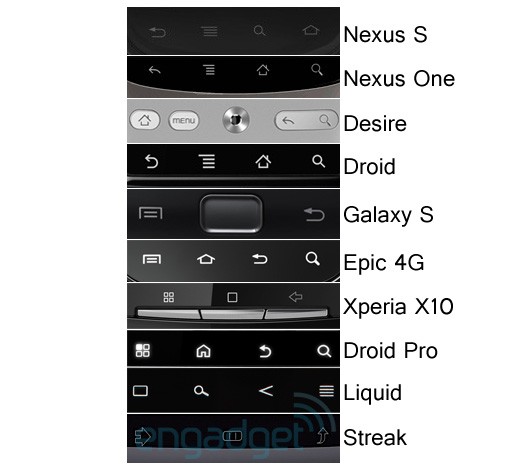
As you can see, even with devices co-developed with Google — the Nexus One and the Nexus S — you can see the difference between the locations of the buttons, albeit slightly.

But is fragmentation an issue? Already we’re seeing Android climbing to the top of the mobile OS charts at a blistering pace and from our own experience, jumping from one manufacturer’s Android device to another is never an issue for us.

What about you? Do you think that the fragmentation of the Android OS is a big issue? Comment us.


[picture credit]

Related Posts with Thumbnails


Android, Mobile Devices, Mobile OS, Nexus One, Nexus S
, , ,
Wanna say something?


10 Comments for Android fragmentation issue visualised

goh

If Android is fragmented, Nokia too. Windows too!
Even iOS itself is fragmented.

lisee

Do not forget android as such is only slightly more than a year old !

These so called fragmentation is what I will call teething problems from googles' relentless pace but which will of course sort itself out in "due time", much like most Google products.

Look at struggling "stable" mozilla firefox, super "unchanging" explorer, unfragmented "symbian etc, what is happening to them now ?

    soyacincau

    Yeah we don't see it as an issue. Despite this "fragmentation" Android is growing at a ferocious pace, always good to have alternatives to the ubiquitous iOS.

Ashraf

The "fragmentation" wont be much of an issue if phone manufacturers allow easy and seemless official updating of Android versions. But obviously this is not the case, some phones are still stuck at version 1.6. Sure, we can take the unofficial flashing route, but why should users be forced to do this?

    soyacincau

    That's exactly the problem, the UI skins manufacturers are adding on top of the plain Android OS is making it difficult to seamlessly update OS versions. This and also the fact that there are numerous permutations of Android devices out there with different screen size and processors, is also slowing down OS upgrades.

    But in terms of usability, we see no problems with the different UI skins on top of the plain Android, its just people won't be getting updates as quickly, if they do at all.

Chew

As a consumer, I like having choices to pick from. Big screen or small screen or with keyboard or without keyboard etc. And all that will change the price factor, which is yet another very important criteria.
I guess one way would be for the phone manufacturers to avoid making their own skins and use plain vanilla Android OS, hence reduce the need to try match their own skins with each OS upgrade. Or just try and keep up with Google. The manufacturer that offers the best support will get more customers.

    soyacincau

    Well said. Manufacturer with the best support wins. We like that! :)

Iskandar

Fragmentation is not just the hardware buttons, but the underlying hardware and thr OS customisations by the different hardware manufacturers. Different screen size & resolution / aspect ratio, different processor speed, ram available etc.

iOS is not fragmented as all iOS devices are using the same OS and almost the same hardware – except for the 1G iPhone which is too old to run the latest apps (games mostly).

Developers would have a hard time to cater for all Android devices, compared to developing a single version for all iOS devices, or even Windows Phone OS!

tigervyh

not really, in hardware sense, but it does cause some delays in the upgrade of OS if we're not using Google branded phones (N1, NS).

So more likely it's just the different wait time for upgrades, like Samsung Galaxy S just got their Froyo, while HTC Desire got their's like 4 months ago… and like N1 is getting their gingerbread now…

HTC Legend gets Android 2.2 upgrade | SoyaCincau

[...] times like this when this Android fragmentation thing starts being a pain in the SD card slot, if you get what we [...]